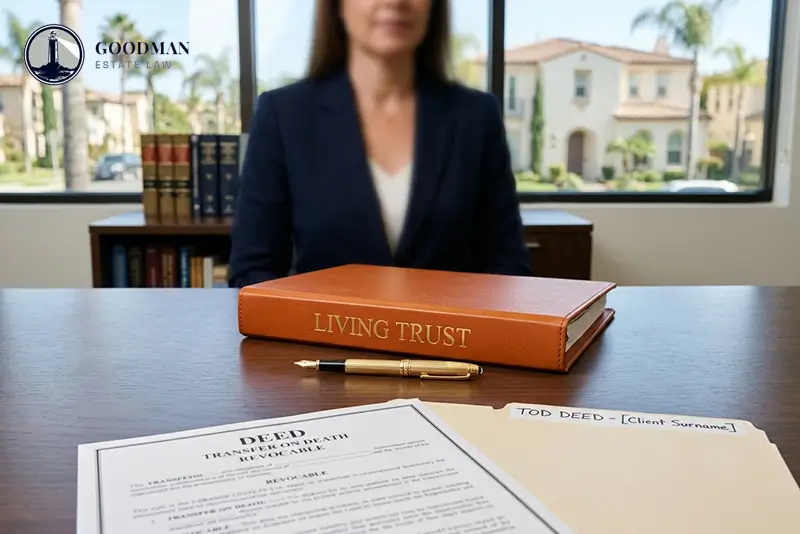
For most Orange County families, the home is the largest asset they own, and keeping it out of probate is a common planning goal. A quick internet search turns up an appealing shortcut: the California revocable transfer on death deed, a short form that can pass a home to a named beneficiary without a court proceeding.
For some people, a TOD deed may be a reasonable tool. For many others, it can leave important gaps. This article explains how a TOD deed works under California law, the formalities that must be followed exactly, and how it compares with a revocable living trust.
Quick Answer
A California revocable transfer on death (TOD) deed lets you name a beneficiary to receive your home at your death without probate. It must be signed, dated, witnessed by two people, notarized, and recorded within 60 days of notarization. It can work for a simple situation, but it does not address incapacity, backup planning, or other assets, so many Orange County families find that a living trust offers broader protection.
What Is a Revocable Transfer on Death Deed?
A revocable TOD deed is a recorded document that transfers real property to one or more named beneficiaries when the owner dies.
During your lifetime, a TOD deed generally changes nothing about your ownership. You can still live in the home, sell it, refinance it, or revoke the deed. The beneficiary has no present ownership interest, and the beneficiary’s creditors cannot reach the property while you are alive. At your death, the property passes to the beneficiary, subject to existing liens and recorded interests.
What Property Can Be Transferred?
California limits TOD deeds to certain types of residential property. Under Probate Code section 5610, a TOD deed may be used for:
- A parcel improved with one to four residential dwelling units, such as a single-family home or a small multiunit property.
- A residential unit in a condominium or other common interest development, along with its share of the common area.
Agricultural land of more than 40 acres is excluded. Commercial property is likewise not covered by the statute, so business owners with commercial real estate generally need a different approach.
The Formalities Must Be Followed Exactly
A TOD deed is short, but California is strict about how it is signed and recorded. A deed that misses a step may be ineffective. Under current law:
- The owner must have capacity. Under section 5620, the owner must have the capacity to contract when signing.
- The owner must sign and date the deed. (Probate Code section 5624.)
- Two witnesses must sign. Two adult witnesses must sign, and they must be present at the same time to witness the owner signing or acknowledging the signature.
- The deed must be notarized. The owner must acknowledge the deed before a notary public.
- The deed must be recorded within 60 days. Under section 5626, the deed is effective only if it is recorded within 60 days after the date it was notarized. Missing this deadline is a common and costly mistake.
California’s TOD deed law is presently set to expire on January 1, 2032, unless the Legislature extends it. Fortunately, a deed signed before that date is not invalidated by the expiration.
Where TOD Deeds Can Fall Short
A properly executed TOD deed may avoid probate for one property. But it is a narrow tool, and several gaps are worth understanding before relying on one.
It Does Not Plan for Incapacity
A TOD deed only operates at death. If you become unable to manage your affairs, it gives no one authority to handle the property for you. That still depends on a durable power of attorney. Our article on why a power of attorney matters during a sudden illness explains why. A living trust, by contrast, lets your successor trustee step in to manage trust property if you become incapacitated.
Backup Planning Can Be Limited
A beneficiary must survive you to receive the property. If a beneficiary dies first, that share lapses. If your only named beneficiary passes away before you and you have not updated the deed, the home may end up back in your estate and potentially in probate, the very result you were trying to avoid.
There is Limited Flexibility
A named beneficiary will receive full ownership of the home immediately upon your death. In other words, leaving the home to a child or grandchild becomes a critical timing question, leaving open the possibility that a very young beneficiary become the recipient. In addition, a TOD deed may not be the right structure for a beneficiary with Special Needs, substance abuse issues, creditors, or other extenuating circumstances.
Multiple Beneficiaries Become Co-Owners
When a TOD deed names several beneficiaries, they generally receive the property as tenants in common in equal shares. That can work well for siblings who agree. It can be harder when one sibling wants to sell and another wants to keep the house, or when one lives in it and the others do not.
Beneficiaries May Face Debts and Paperwork
A TOD beneficiary may be personally liable for certain debts of the deceased owner, generally limited to the property’s value at death minus liens, unless an estate administration addresses those debts. Beneficiaries also have filing responsibilities, including the change in ownership statement required for property tax purposes. Prop 19 rules on parent-child transfers still apply, as our article on Proposition 19 and parent-child transfers explains.
It Covers Only One Asset
A TOD deed addresses one property. Bank accounts, investments, vehicles, and personal belongings still need their own plan, through beneficiary designations, a will, or a trust. Our article on beneficiary designations explains how those designations can override other documents if they are not coordinated.
It Can Be Contested
A transfer by TOD deed can be challenged by the owner’s personal representative or another interested person. For example, an immediate family member who was not named as beneficiary may challenge the deed on grounds that the owner lacked capacity or was unduly influenced. A deed signed without legal guidance may be easier to question.
How a Living Trust Compares
A revocable living trust can also pass your home without probate, and it does much more. A trust can:
- Name a successor trustee to manage your property if you become incapacitated, not only after death.
- Hold all of your assets under one plan, including your home, accounts, and investments.
- Name backup beneficiaries and spell out what happens if a beneficiary dies before you.
- Hold a share in trust for a young adult, a person with special needs, or a beneficiary who needs help managing money.
- Direct whether a home should be sold or kept, and how proceeds should be divided.
A trust involves more work at the outset, including transferring assets into the trust. Our article on funding your trust explains why that step matters. For many families, the broader protection is worth it. Our comparison of a will versus a living trust covers the basics.
When a TOD Deed May Make Sense
A TOD deed may be worth considering in limited situations, such as a single person with one adult child, one home, and few other assets, where incapacity planning is handled separately. Even then, it is wise to have the deed reviewed so the witnessing and recording requirements are met and the deed fits with the rest of the plan.
Consider a widower in La Habra who owns his condo free and clear and wants it to go to his only daughter. A TOD deed might accomplish that. But if his daughter were to pass away before him, or if he developed dementia and the condo needed to be sold to pay for his care, a living trust with a successor trustee would likely give his family far more flexibility.
If You Already Signed a TOD Deed
If you signed a TOD deed in the past, it is worth confirming that it was witnessed and notarized correctly and recorded within 60 days, and that the named beneficiary is still the person you want to receive the property. If you later create a living trust, the TOD deed should be reviewed as part of that process so the two documents do not conflict. A deed can be revoked by recording a properly signed and notarized revocation.
Talk With an Orange County Estate Planning Attorney
If you are considering a transfer on death deed, or you already signed one and want to make sure it works as intended, Brett Goodman can review your options and explain how a TOD deed compares with a living trust for your family. Call Goodman Estate Law at (949) 768-1491 or schedule a consultation.
Frequently Asked Questions
About the Author
Brett J. Goodman is a California-licensed estate planning attorney serving families throughout Orange County from his office in Anaheim. He earned his Juris Doctor from Chapman University’s Dale E. Fowler School of Law and his undergraduate degree in Middle Eastern Studies and Arabic from Brigham Young University. Brett began his professional career at PricewaterhouseCoopers before moving into estate law. He serves as a board member of the J. Reuben Clark Law Society, Orange County Chapter, and is fluent in Spanish. Brett grew up in Tustin and lives in Villa Park with his wife and three children.
Compliance Disclaimer
This article is general information and not specific legal advice. Reading it does not create an attorney-client relationship. Laws change and every family is different, so please consult a California-licensed attorney about your own situation before acting on anything you read here.
Sources
- California Probate Code section 5600, Application and sunset (FindLaw): https://codes.findlaw.com/ca/probate-code/prob-sect-5600/
- California Probate Code section 5610, Real property defined (FindLaw): https://codes.findlaw.com/ca/probate-code/prob-sect-5610/
- California Probate Code section 5620, Capacity (FindLaw): https://codes.findlaw.com/ca/probate-code/prob-sect-5620/
- California Probate Code section 5624, Execution requirements (FindLaw): https://codes.findlaw.com/ca/probate-code/prob-sect-5624/
- California Probate Code section 5626, Recording within 60 days (FindLaw): https://codes.findlaw.com/ca/probate-code/prob-sect-5626/
- California Probate Code section 5650, Effect during transferor’s life (FindLaw): https://codes.findlaw.com/ca/probate-code/prob-sect-5650/
- California Probate Code section 5652, Effect at death (FindLaw): https://codes.findlaw.com/ca/probate-code/prob-sect-5652/
- California Probate Code section 5674, Limit on beneficiary liability (FindLaw): https://codes.findlaw.com/ca/probate-code/prob-sect-5674/
- California Probate Code section 5690, Contest (FindLaw): https://codes.findlaw.com/ca/probate-code/prob-sect-5690/

Brett J. Goodman is the founder and lead attorney at Goodman Estate Law, based in Laguna Hills, CA. The firm specializes in Estate Planning, Trust Administration, and Probate, helping individuals and families create or update wills and trusts. With a focus on personalized, compassionate, and professional guidance, Goodman Estate Law ensures clients’ assets and futures are protected during every stage of estate planning.